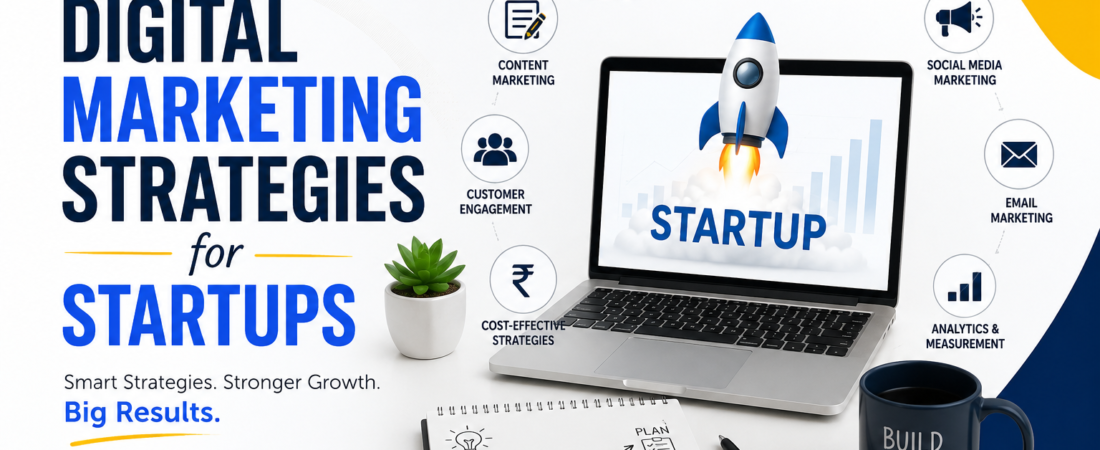
Starting a new business is exciting, but growing it in a competitive market can be challenging. Startups often face limited budgets, low brand awareness, strong competition, and difficulties attracting their first customers. This is where effective digital marketing becomes essential.
Digital marketing allows startups to reach potential customers through search engines, social media platforms, websites, email campaigns, and online advertising. Unlike many traditional marketing methods, digital marketing offers measurable results and helps businesses understand which activities generate leads, sales, and customer engagement.
However, simply creating social media accounts or running advertisements is not enough. Startups need a clear marketing plan that aligns with their business goals, target audience, and available budget.
In this guide, we will explore the top 10 digital marketing strategies for startups that can help you build brand awareness, attract the right audience, generate qualified leads, and achieve sustainable business growth.
Whether you are launching a technology company, a local business, an online store, or a service-based startup, these strategies will help you build a strong digital presence.
Why Is Digital Marketing Important for Startups?
Digital marketing helps startups compete more effectively by making it easier to reach specific audiences, test marketing ideas, and measure campaign performance.
Here are some important benefits:
Cost-effective promotion: Start with organic marketing and small advertising campaigns that fit your budget.
Targeted audience reach: Connect with people based on their interests, location, search intent, and other relevant characteristics.
Measurable performance: Track website traffic, leads, conversions, and advertising costs.
Brand awareness: Build recognition through consistent content and online visibility.
Customer relationships: Communicate with customers through email, social media, and other digital channels.
Scalable growth: Expand successful campaigns as your business and budget grow.
The key is to select the right channels rather than trying every marketing tactic at once.
1. Search Engine Optimization (SEO)
Search Engine Optimization (SEO) is one of the most valuable long-term digital marketing strategies for startups. It helps your website appear in search engine results when potential customers search for products, services, or information related to your business.
For example, if you run a digital marketing agency, you might want your website to appear when users search for “digital marketing services for startups” or “SEO agency in Pune.”
Unlike paid advertising, organic search traffic does not require you to pay for every click. However, SEO requires consistent effort, useful content, technical improvements, and time to produce results.
How startups can implement SEO
Conduct keyword research to understand what your target customers search for.
Optimize page titles, meta descriptions, headings, and URLs.
Publish helpful blogs that answer customer questions.
Improve website loading speed and mobile usability.
Use relevant internal links to connect related website pages.
Optimize images with descriptive file names and alt text.
Set up Google Search Console to monitor search performance.
Example: A startup selling accounting software can publish blogs about GST invoicing, small-business accounting, and financial management. These articles can attract people searching for solutions and introduce them to the company’s software.
SEO is particularly useful for startups that want to build credibility and generate consistent website traffic over time.
2. Content Marketing
Content marketing involves creating and distributing valuable information to attract, educate, and engage your target audience. Rather than promoting your product in every message, you provide useful content that helps customers solve real problems.
Startups can use content marketing to demonstrate expertise, build trust, answer common questions, and support customers throughout their buying journey.
Types of content startups should create
Educational blog posts and how-to guides
Case studies and customer success stories
Short-form videos and reels
Infographics and downloadable resources
Industry reports and practical checklists
Product demonstrations and tutorials
How to create an effective content strategy
First, identify the problems your ideal customers face. Then create content that provides practical solutions to those problems.
For example, a startup providing website development services could publish articles such as “How to Build a Business Website” or “Essential Website Features for Startups.”
Share each article across relevant social media platforms and include links to useful service pages where appropriate.
Focus on quality rather than publishing large amounts of generic content. Original insights, real examples, clear explanations, and accurate information make your content more valuable.
Content marketing also supports SEO by creating relevant pages that can answer different customer searches. Google’s SEO guidance emphasizes helpful, reliable, people-first content rather than content created merely to manipulate search rankings.
3. Social Media Marketing
Social media marketing helps startups build brand awareness, communicate with customers, and create a community around their products or services.
Platforms such as Instagram, Facebook, LinkedIn, and YouTube offer different opportunities depending on your audience and business model.
For example, a fashion startup may benefit from Instagram reels, while a B2B software startup may find LinkedIn content and professional communities more relevant.
How startups can use social media effectively
Select two or three platforms where your target audience is active.
Create a consistent content calendar.
Share educational posts, behind-the-scenes content, and product demonstrations.
Use short videos to explain your product or service.
Respond to comments and messages promptly.
Share genuine customer feedback with permission.
Track engagement, website clicks, inquiries, and leads.
Follow the 80/20 content approach
As a practical starting point, allocate around 80% of your content to educational, entertaining, or community-focused posts and 20% to direct promotions. This is a planning guideline, not a fixed rule.
For instance, a marketing consultancy can share advertising tips, SEO checklists, campaign lessons, and client-approved case studies alongside posts promoting its services.
Pro tip: Avoid chasing followers without considering business outcomes. A smaller audience that matches your target customers may be more valuable than a large audience that never converts.
4. Pay-Per-Click Advertising (PPC)
Pay-per-click advertising allows startups to promote their products or services through paid placements and pay for clicks under applicable campaign pricing models.
Google Ads is particularly useful for reaching people who are actively searching for solutions. Meta Ads can help businesses reach relevant audiences on Facebook and Instagram.
Paid advertising can produce traffic quickly, but results depend on your targeting, offer, landing page, competition, and budget.
Google Ads for startups
Google Search Ads can help you reach users with strong purchase intent.
For example, a startup offering website development services might target relevant searches such as “website developer for small business” or “startup website development services.”
Use tightly themed keyword groups, relevant ad copy, and landing pages that directly address the searcher’s needs.
Meta Ads for startups
Meta Ads can be useful for generating awareness, inquiries, website visits, and sales.
Startups can test different creatives, audience segments, and offers to discover what attracts qualified prospects.
Best practices for PPC campaigns
Define the campaign objective before launching.
Start with a budget your business can afford to test.
Use relevant keywords or audience targeting.
Create dedicated landing pages.
Install and verify conversion tracking.
Monitor cost per lead, conversion rate, and customer acquisition cost.
Pause underperforming ads and scale campaigns that demonstrate profitable results.
Remember that advertising clicks are not the same as customers. Measure whether your campaigns generate meaningful business outcomes before increasing your spending.
5. Email Marketing
Email marketing enables startups to communicate directly with people who have chosen to receive their messages. It is useful for nurturing leads, announcing new products, sharing educational resources, and encouraging repeat purchases.
Unlike social media, where platform algorithms influence visibility, an email list gives your business a direct communication channel with subscribers.
How startups can build an email marketing strategy
Build a permission-based list: Offer something useful, such as a checklist, free guide, webinar, or product demonstration, in exchange for voluntary sign-ups.
Segment subscribers: Group subscribers according to relevant characteristics, such as interests, customer stage, or previous purchases.
Create helpful campaigns: Share educational content, product updates, special offers, and relevant resources.
Automate follow-ups: Set up welcome emails and appropriate follow-up sequences based on subscriber actions.
Measure performance: Track clicks, conversions, unsubscribes, and revenue where measurable. Use email open rates carefully because privacy features can make them less reliable.
Example of email marketing for startups
Imagine a startup selling project management software. It could offer a free project-planning template to website visitors. Subscribers could then receive a welcome email, a tutorial showing how to use the template, and an invitation to try the software.
The objective is to help potential customers understand the product before asking them to purchase it.
Always follow applicable privacy and email marketing requirements, provide a clear unsubscribe option, and avoid buying email lists.
6. Website Optimization and Conversion Rate Optimization
Your website is often the first place potential customers visit to learn about your startup. A slow, confusing, or untrustworthy website can cause visitors to leave without taking action.
Website optimization focuses on making the site useful, easy to navigate, and effective at converting visitors into leads or customers.
Conversion Rate Optimization (CRO) involves improving the percentage of visitors who complete a desired action, such as submitting a form, booking a consultation, or purchasing a product.
Essential website improvements
Ensure your website works well on mobile devices.
Improve page speed and remove unnecessary elements.
Use clear headings that explain your value proposition.
Add visible calls to action such as “Get a Quote” or “Book a Consultation.”
Make contact information easy to find.
Include genuine testimonials and relevant case studies.
Simplify forms by requesting only necessary information.
Check that forms, payment pages, and tracking work correctly.
Example of website optimization
Suppose 1,000 people visit your startup’s website each month, and 20 submit an inquiry. Your conversion rate is 2%.
If you improve your landing page and receive 30 inquiries from the same 1,000 visitors, the conversion rate becomes 3%.
That represents 10 additional inquiries without increasing website traffic. These numbers are illustrative, but they show why improving conversion rates can be as important as attracting more visitors.
Test changes systematically rather than redesigning everything at once. This helps you understand which improvements actually make a difference.
7. Influencer Marketing and Strategic Partnerships
Influencer marketing involves collaborating with creators who have an audience relevant to your business. It can help startups introduce their products to potential customers through demonstrations, reviews, tutorials, and sponsored content.
Startups do not necessarily need celebrity influencers. Smaller creators with a focused, engaged audience may be more suitable for a limited budget.
Strategic partnerships offer another opportunity. You can collaborate with complementary businesses that serve a similar audience without directly competing with you.
How startups can implement influencer marketing
Identify creators whose audiences match your target customers.
Review their content quality, engagement, and audience relevance.
Establish clear campaign goals and deliverables.
Agree on budgets, timelines, usage rights, and disclosures.
Use trackable links or campaign-specific codes where appropriate.
Measure qualified traffic, inquiries, conversions, and sales.
Example
A startup selling healthy snacks could partner with food creators who regularly share recipes and nutrition-focused content. The creators might demonstrate how to use the product in everyday meals.
Similarly, a software startup could collaborate with industry educators who create tutorials for its target audience.
Choose partnerships based on audience fit and credibility, not follower count alone. Sponsored endorsements should be disclosed in accordance with applicable advertising rules.
8. Local SEO and Google Business Profile
Local SEO is especially important for startups serving customers in a particular city, region, or service area. It helps your business improve its visibility in relevant local searches.
For example, a startup providing digital marketing services in Pune may want to reach people searching for a digital marketing agency in Pune or Pimpri-Chinchwad.
Local SEO strategies for startups
Create and verify a Google Business Profile if your business is eligible.
Keep your business name, address, phone number, and operating hours accurate.
Select relevant business categories and describe your services clearly.
Add genuine photos of your office, team, products, or work.
Ask actual customers for honest reviews without offering prohibited incentives.
Respond professionally to reviews.
Create useful website pages for your real service areas.
Keep your website contact details consistent with your business profile.
If your startup operates entirely online without serving customers at an eligible physical location, check Google’s Business Profile eligibility rules before creating a listing.
Why local SEO matters
Local search visibility can help customers discover your business when they are actively looking for nearby services. A complete profile and helpful website can make it easier for them to contact you, request directions, or explore your offerings.
Local SEO is particularly valuable for consultants, agencies, clinics, educational institutes, home-service businesses, and local retailers.
9. Video Marketing
Video marketing allows startups to explain complex ideas, demonstrate products, share customer experiences, and communicate their brand personality.
Many people prefer watching a short demonstration rather than reading a long explanation. Video can therefore help your audience understand how your product works and whether it meets their needs.
You do not need an expensive production setup to begin. A smartphone, clear audio, good lighting, and a useful message can be enough for many formats.
Video content ideas for startups
Product demonstrations
Tutorials and educational videos
Frequently asked questions
Founder introductions
Behind-the-scenes clips
Customer testimonials with permission
Case studies and project walkthroughs
Short videos addressing common customer problems
How to make video marketing effective
Start with a specific audience problem and explain the solution clearly. Capture attention early, keep the video focused, and include captions where useful.
Adapt the format to each platform instead of publishing identical content everywhere without considering the audience.
For example, a startup offering website development could create a short video explaining five common website mistakes, followed by a longer tutorial showing how to improve a homepage.
Measure more than views. Watch time, meaningful engagement, website visits, qualified inquiries, and conversions can help you understand whether your videos support your business goals.
10. Analytics, Marketing Automation, and AI Tools
The tenth strategy is to use data, automation, and AI tools to make your marketing more efficient.
Startups often work with small teams, which makes it important to prioritize activities that deliver measurable value. Analytics helps you understand customer behavior, while automation reduces repetitive work.
AI tools can assist with research, content outlines, brainstorming, campaign variations, and customer support workflows. However, human review remains essential for accuracy, originality, brand consistency, and privacy.
Essential tools startups can consider
Google Analytics 4: Understand website traffic and user interactions.
Google Search Console: Monitor search visibility, clicks, and indexing issues.
Google Tag Manager: Manage supported website tracking tags.
CRM software: Organize leads, customer details, and sales follow-ups.
Email automation tools: Send scheduled and behavior-based campaigns.
AI writing assistants: Brainstorm ideas, organize research, and develop initial drafts.
Reporting dashboards: Combine relevant marketing metrics for easier review.
Choose tools according to your needs, budget, and technical capabilities rather than subscribing to every available platform.
Important metrics to monitor
Metric | What it tells you |
|---|---|
Website traffic | How many visits your website receives |
Conversion rate | The percentage of visitors completing a desired action |
Cost per lead | How much you spend to generate a lead |
Customer acquisition cost | The average cost of acquiring a customer |
Return on ad spend | Revenue attributed to advertising relative to ad spend |
Customer lifetime value | The estimated value a customer generates over the relationship |
Set up tracking before launching major campaigns wherever possible. Review performance regularly and use the findings to improve your strategy.
For example, if your website receives traffic but very few inquiries, investigate the relevance of the traffic, page content, user experience, and conversion process before spending more on advertising.
How to Choose the Right Digital Marketing Strategy for Your Startup
Not every startup needs all ten strategies immediately. Your priorities should depend on your business model, target customers, budget, and growth stage.
Startup goal | Strategies to prioritize |
|---|---|
Build long-term organic traffic | SEO and content marketing |
Generate leads quickly | Google Ads and conversion optimization |
Increase brand awareness | Social media and video marketing |
Reach nearby customers | Local SEO and Google Business Profile |
Nurture existing leads | Email marketing and CRM automation |
Build trust in a niche | Influencer marketing and partnerships |
Improve marketing efficiency | Analytics, automation, and AI tools |
A practical approach is to select two or three primary channels, establish a baseline, and improve them before expanding into additional activities.
A Simple 90-Day Digital Marketing Plan for Startups
Use this example as a starting framework. Adjust the activities to your business, resources, and customer buying cycle.
Days 1–30
Foundation
Build the foundation
Define your ideal customer and value proposition.
Optimize your website and contact forms.
Research relevant keywords.
Set up analytics and conversion tracking.
Create your initial content calendar.
Days 31–60
Execution
Launch marketing activities
Publish helpful blogs and social media content.
Start a targeted advertising test if your budget allows.
Build a permission-based email list.
Improve your local presence if applicable.
Test different messages and calls to action.
Days 61–90
Optimization
Measure and improve
Review traffic, leads, and sales.
Identify your strongest marketing channels.
Improve low-converting landing pages.
Refine your advertising targeting and creatives.
Allocate more resources to proven opportunities.
At the end of 90 days, evaluate progress against your original goals. Some paid campaigns may provide early insights, while SEO and content marketing may require a longer period to show meaningful results.
Common Digital Marketing Mistakes Startups Should Avoid
Even a well-designed marketing plan can fail if execution is inconsistent. Avoid these common mistakes:
1. Targeting everyone: Define a specific target audience instead of trying to appeal to every potential customer.
2. Ignoring SEO: Build your website and content with search visibility in mind from the beginning.
3. Spending without tracking: Set up conversion measurement so you can evaluate the business impact of campaigns.
4. Publishing without a plan: Maintain a realistic content schedule and prioritize topics relevant to your audience.
5. Expecting instant results: Different marketing channels have different timelines. Evaluate progress using realistic expectations.
6. Ignoring mobile users: Check your website, forms, and landing pages on mobile devices.
7. Copying competitors blindly: Learn from competitors, but develop a distinct value proposition and original content.
8. Focusing only on vanity metrics: Followers and impressions can be useful indicators, but leads, sales, retention, and profitability are often more important.
Avoiding these mistakes helps startups use their time and budget more effectively.
Frequently Asked Questions (FAQs)
1. What are the best digital marketing strategies for startups?
SEO, content marketing, social media marketing, PPC advertising, email marketing, website optimization, influencer partnerships, local SEO, video marketing, and analytics are useful options. The best combination depends on your audience, goals, and budget.
2. How much should a startup spend on digital marketing?
There is no universal budget that works for every startup. Begin with an amount your business can afford, prioritize the channels most relevant to your customers, and measure the results. Include advertising spend, software, content creation, and professional support when calculating total costs.
3. Is SEO better than paid advertising for startups?
Neither is universally better. SEO can build long-term organic visibility, while paid advertising can help test offers and reach targeted audiences more quickly. Many startups benefit from combining both when their budget allows.
4. How long does digital marketing take to show results?
Paid advertising may generate initial traffic or leads soon after launch, although profitable performance is not guaranteed. SEO and content marketing generally take longer to establish visibility. Results depend on competition, website quality, resources, and the consistency of your efforts.
5. Can startups do digital marketing without an agency?
Yes. Founders can manage many activities themselves using accessible tools and learning resources. An agency or consultant may help when the business needs specialized expertise, faster execution, or support across multiple channels.
6. Which digital marketing tools are useful for startups?
Google Analytics 4, Google Search Console, a suitable CRM, email marketing software, and social media scheduling tools can help. Select tools based on your goals, and verify that tracking and privacy settings are configured correctly.
7. Why is content marketing important for startups?
Content marketing helps startups answer customer questions, demonstrate expertise, build trust, support SEO, and educate prospects before they make a purchasing decision.
8. How can a startup generate leads online?
A startup can attract leads through search optimization, targeted ads, helpful content, landing pages, social media, email marketing, and relevant partnerships. Clear offers and easy-to-use contact forms can help convert interested visitors into inquiries.
Conclusion
Building a successful startup requires more than an excellent product or service. You also need a clear strategy for reaching the right customers, communicating your value, and turning interest into sales.
These top 10 digital marketing strategies for startups provide a practical starting point for building brand awareness, attracting qualified leads, improving conversions, and developing lasting customer relationships.
Begin with a strong website, understand your target audience, create useful content, and select marketing channels that align with your business goals. Measure your results consistently and improve your approach using real customer and campaign data.
Remember that digital marketing is an ongoing process rather than a one-time activity. With a clear plan, consistent execution, and a focus on customer needs, startups can build a stronger online presence and create opportunities for sustainable growth.